The Rise of the Everything Exchange in Australia
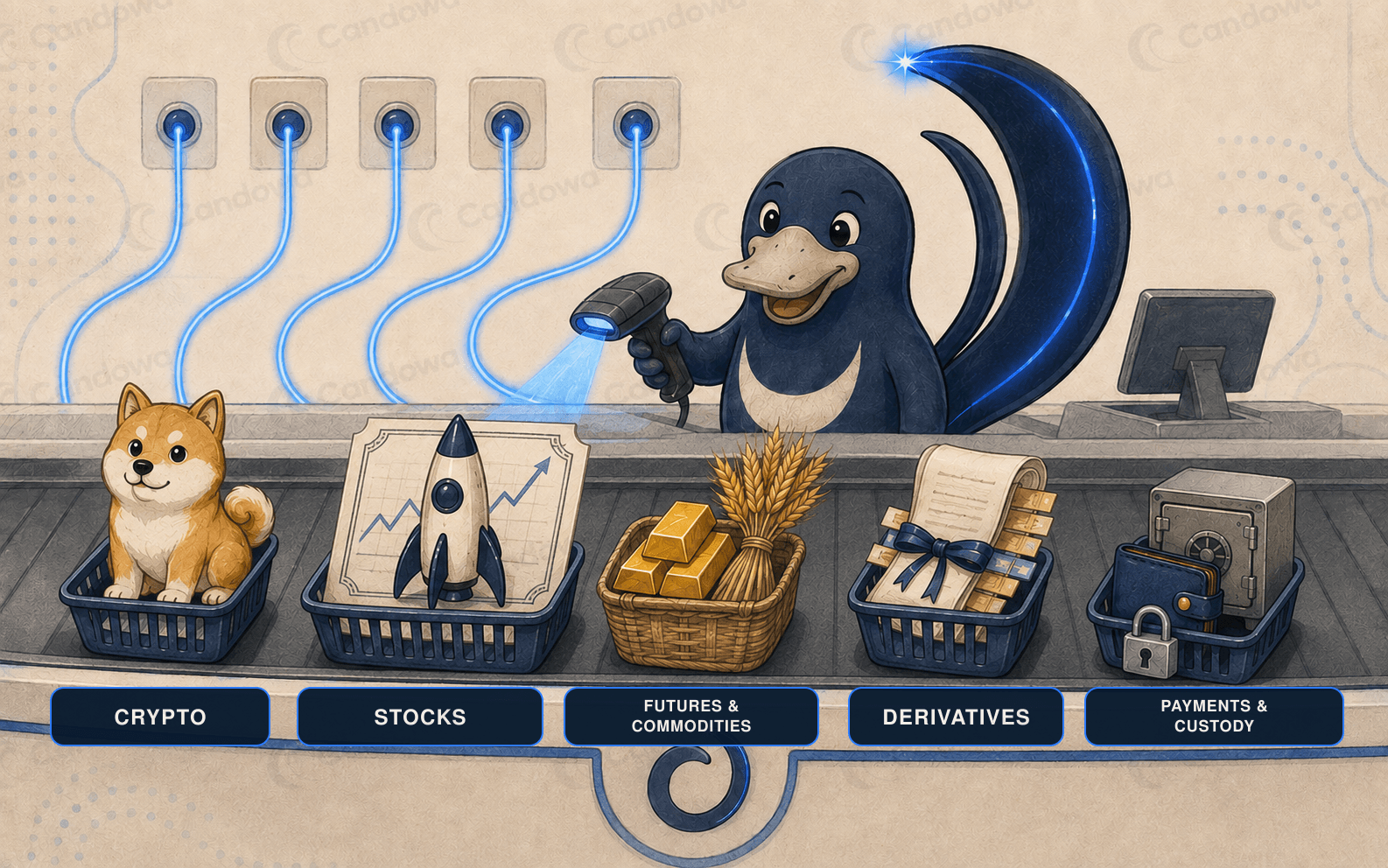
How crypto exchanges are expanding into stocks, commodities and financial services—and why Australia is likely to develop a more modular, regulated model.
Candowa Market Report | August 2026
Last reviewed | 14 August 2026
Research scope
This report analyses publicly available regulatory guidance, product disclosures and platform materials. Product access was not tested through individual customer accounts. Availability can depend on location, account type, eligibility and changing product terms. References to an Australian-facing webpage do not, by themselves, establish that a product is available to Australian customers.
Executive Summary
Crypto exchanges are expanding beyond crypto trading.
Across global markets, some platforms are adding tokenised equities, commodities, derivatives, payments and other financial services. This report uses Everything Exchange as an analytical label for that direction: a customer environment through which several forms of financial exposure can be accessed from one account or interface. It is not a formal Australian regulatory category.
Australia is participating in this shift, but its model is unlikely to resemble an unrestricted offshore multi-asset platform.
The more plausible Australian structure combines:
One customer-facing interface;
Separate crypto, securities, tokenised-asset and derivatives modules;
Multiple issuers, licensees, custodians and service providers;
Product-specific eligibility rules, disclosures and customer protections.
Swyftx’s distribution of contracts for difference issued by Eightcap offers a publicly documented Australian example. International developments at Kraken and OKX illustrate other possible directions, particularly tokenised assets, but global capability should not be confused with Australian availability.
Kraken states that xStocks are not available in Australia. OKX publishes Australian-facing material about Unified Tokenized Stocks, while its product information also states that access depends on region and account eligibility. Each product therefore needs to be assessed through its governing terms, issuer structure and customer-access rules—not merely through the website on which it appears.
Candowa’s central assessment is:
Australia’s Everything Exchange is unlikely to be built under one licence or by one product issuer. A more credible model is a unified customer experience supported by multiple regulated products, licensed entities and specialist partners.
What Is an Everything Exchange?
An Everything Exchange is more than a crypto exchange with a longer list of tokens. It brings several previously separate financial activities into one customer environment.
Depending on the platform and jurisdiction, this may include:
Crypto spot trading;
Crypto derivatives;
Tokenised stocks and exchange-traded funds;
Stock, index and commodity CFDs;
Multi-asset perpetual contracts;
Traditional shares and ETFs;
Payments and cards;
Lending, yield or wealth products.
The customer proposition is convenience: fewer accounts, a more consistent interface and the ability to manage different forms of financial exposure in one place. The legal and economic reality can be considerably less uniform.
Product label | What the customer may receive |
|---|---|
Traditional share | Legal or beneficial ownership through a brokerage and custody structure |
Tokenised share | A token backed by, linked to or tracking an underlying security, subject to the issuer’s terms |
Synthetic stock token | Price exposure without direct ownership of the underlying company |
CFD | A contract with an issuer based on movements in the price of an underlying asset |
Perpetual contract | A leveraged, cash-settled derivative without a fixed expiry date |
Gold token | A token backed by, or designed to track, physical gold under a particular product structure |
These descriptions are general only. The rights, risks, backing arrangements and regulatory treatment of any product depend on its specific design and documentation.
A customer selecting “Apple”, “Tesla” or “gold” on a trading screen may therefore be purchasing very different products. Some tokenised equities are backed by underlying shares but do not give the holder conventional shareholder rights. Other products provide synthetic exposure only.
OKX’s Unified Tokenized Stocks FAQ, for example, states that the product provides price exposure rather than direct ownership of the underlying equity and does not carry voting rights unless expressly provided by the relevant issuer.
The central risk is straightforward:
A broader product menu does not necessarily give customers ownership of a broader range of assets.
Why Exchanges Are Expanding Beyond Crypto
Several commercial and technological pressures are encouraging crypto exchanges to broaden their product range.
Differentiation within crypto is becoming harder
Large platforms often compete across similar dimensions: asset selection, fees, liquidity, leverage and access to local payment methods. These factors remain important, but expanding into other product categories creates additional sources of differentiation and revenue.
Existing customer infrastructure can support distribution
An exchange that already manages onboarding, identity verification, funding and account access may have a distribution advantage. It can use that infrastructure to connect customers with products manufactured by another provider, provided the legal roles and customer protections are clear.
This does not mean that customers universally want one financial account. It means that platforms see potential value in reducing the friction between previously separate products.
A broader product mix may reduce dependence on crypto cycles
Crypto trading activity can be cyclical. Equities, commodities, payments and other services may broaden the platform’s addressable market and create additional forms of customer activity.
Whether this improves sustainable economics depends on demand, revenue sharing, compliance costs and the operational burden created by each additional product.
Tokenisation can connect conventional exposure with blockchain infrastructure
Depending on product design and applicable restrictions, tokenised assets may support blockchain-based settlement, fractional access, stablecoin trading or transfers to compatible wallets.
These features are not universal. Transferability, redemption, backing, custody and decentralised-finance compatibility must be confirmed for each product.
The broader direction is nevertheless clear: some crypto exchanges are evolving from asset marketplaces into financial-product distribution platforms.
Why Australia Is Likely to Develop a Different Model
The global product vision may appear unified, but Australia’s regulatory structure remains activity- and product-specific.
Registration as a digital currency exchange with AUSTRAC addresses anti-money-laundering and counter-terrorism-financing obligations. It does not, by itself, authorise a business to issue or distribute every form of financial product.
Under the existing financial-services regime, a crypto-related service may require an Australian Financial Services Licence, relevant authorisations, disclosure documents, a Target Market Determination and compliance with design and distribution obligations. The answer depends on what the product is and what the business does.
ASIC has continued to emphasise that providers must assess whether their digital-asset products and services fall within the financial-services framework. Its sector-wide transitional no-action position required relevant firms to apply for an AFS licence, seek a variation or take another permitted compliance route by 30 June 2026.
Australia has also enacted the Corporations Amendment (Digital Assets Framework) Act 2026. The Act received Royal Assent on 8 April 2026 and is scheduled to commence on 9 April 2027, introducing a licensing framework for digital asset platforms and tokenised custody platforms.
Traditional securities, CFDs, tokenised products, payments, credit and managed investment products can still involve different regulatory responsibilities.
This produces two connected layers:
A customer-facing platform designed to make the experience feel coherent.
A product and compliance structure involving several legal entities, licences and specialist providers.
One brand may therefore sit above several arrangements. A platform might operate crypto spot services through an AUSTRAC-registered entity, distribute CFDs issued by an AFSL holder, provide access to third-party tokenised assets, use separate custodians and rely on banking or payment partners for fiat services.
The ability to coordinate these relationships may become more valuable than manufacturing every product internally.
In Australia, the Everything Exchange is likely to be an exercise in regulatory and product orchestration—not simply product expansion.
Four Emerging Models
There is no single route from crypto exchange to multi-asset platform. Four broad models are visible.
1. CFD Distribution
Swyftx’s leverage offering provides a current Australian example of partnership-based expansion.
According to Eightcap’s July 2026 Product Disclosure Statement, Eightcap is the CFD issuer and principal. Swyftx holds AFSL 568543 and acts as distributor, arranging for Eightcap’s CFDs to be made available through the derivatives trading platform. Swyftx may provide general financial product advice but not personal advice.
This structure allows the customer-facing platform to add exposure to shares, commodities, metals and other underlying assets without issuing every contract itself.
Potential advantages include:
Faster access to an established issuer’s infrastructure;
A broader product range within a familiar interface;
Separation between product manufacturing and customer distribution.
The limits are equally important. A CFD provides leveraged price exposure, not ownership of the underlying share or commodity. The platform must explain the issuer, distributor, counterparty and complaint-handling responsibilities clearly.
The case demonstrates that an Australian exchange can become multi-asset without becoming the issuer of every product.
2. Tokenised Assets
Tokenised assets are closely aligned with crypto-native infrastructure, but their structures and customer rights vary.
Kraken describes xStocks as tokenised products backed by underlying equities. Its Australian support page expressly states that xStocks are not available in Australia.
OKX’s Unified Tokenized Stocks model consolidates supported third-party tokenised-stock products into a common ticker and order book. Its FAQ states that OKX acts as distributor and trading venue, while third-party providers issue and manage the underlying tokens. The product provides price exposure rather than direct ownership of the equity.
OKX has published information about these products through its Australian-facing site. However, the same materials state that availability depends on region and account eligibility. The existence of an Australian-facing page should therefore not be presented as confirmation of Australian customer access.
Potential benefits of tokenised assets may include:
Blockchain-based transfer and settlement;
Fractional or continuous trading access;
Integration with stablecoin liquidity;
Compatibility with supported wallets or applications.
The relevant questions are product-specific: Who issued the token? What backs it? Where is the underlying asset held? How does redemption work? What happens to dividends and corporate actions? What rights does the holder have?
3. Multi-Asset Perpetuals
Some international exchanges use perpetual-contract infrastructure to provide leveraged exposure to equities, indices, commodities and metals.
This model can reuse existing collateral, margin and liquidation systems while giving customers a relatively consistent trading experience. It does not require the platform to provide direct ownership or conventional custody of every referenced asset.
The same features create regulatory and customer-protection challenges. Leverage, liquidation, continuous trading and synthetic exposure can be difficult to understand. For Australian retail distribution, product design, target-market assessment, disclosure and distribution controls are therefore central.
ASIC’s successful action against Bit Trade, Kraken’s Australian operator, over design and distribution failures relating to a margin product illustrates the consequences of getting those obligations wrong.
Multi-asset perpetuals may consequently be easier to offer offshore or to restricted customer categories than to Australia’s mass retail market.
4. Traditional Brokerage
The fourth model combines crypto services with conventional share and ETF brokerage.
This can provide clearer ownership through established brokerage, custody and clearing arrangements. It may appeal to customers seeking investment ownership rather than synthetic trading exposure.
It is also expensive and difficult to reproduce across jurisdictions. Securities brokerage requires local licensing, custody, market access, tax reporting and corporate-action processing.
For this reason, conventional brokerage may be a longer-term direction for large platforms, while distribution partnerships and selected tokenised products may provide more practical near-term routes.
The Australian Market Today
Australia does not yet have one definitive Everything Exchange. Current and potential participants can instead be viewed in three broad groups.
Platform position | Likely direction | Australian relevance |
Local exchange using regulated product partners | CFDs or selected tokenised products | A practical near-term route where roles and licences are clearly documented |
International platform with Australian operations | Tokenisation, derivatives or brokerage capabilities | Global capability may be substantial, but availability must be verified product by product |
Offshore multi-asset derivatives platform | Equity, index and commodity perpetuals | Product range may be broad, while the Australian pathway may be restricted or unclear |
Swyftx and Eightcap currently provide a useful public example because the issuer and distributor roles are described in an Australian PDS.
International platforms may possess broader technology and product catalogues. That does not establish that every global product is available, legally transferable or commercially appropriate in Australia.
The distinction becomes more important as exchange websites, wallets and decentralised interfaces overlap. Customers may encounter a product through one brand while another entity issues it, holds the assets or bears the contractual responsibility.
What Will Determine Credible Execution?
The platforms best positioned to execute this model are unlikely to be identified by product count alone. Five capabilities matter more.
Regulatory orchestration
Platforms must coordinate registration, financial-services licensing, issuers, distributors, custodians and banking partners without creating gaps in responsibility.
Product clarity
Customers need to know whether they are purchasing an asset, token, CFD or another derivative. Disclosure is not only a compliance requirement; it is fundamental to informed consent and trust.
Coherent customer experience
Separate product structures can feel consistent without disguising their legal differences. Customers are likely to expect understandable onboarding, funding, reporting, account management and support.
Local trust and distribution
A sophisticated global product is not automatically suitable for Australia. The platform must explain it in locally meaningful terms and support it through credible operations and clearly identified responsibility.
Sustainable economics
Each additional issuer or provider introduces cost, revenue sharing and operational dependency. The model must be supported by sufficient customer demand and realistic licensing, liquidity, support and risk-management economics.
A platform does not need to manufacture every product. It does need to make the structure understandable and the allocation of responsibility credible.
Candowa Outlook: The Next 12–24 Months
The following points are Candowa’s forward-looking assessment rather than confirmed market outcomes.
Multi-entity structures will become more visible. Australia is unlikely to rely on one authorisation covering crypto spot services, securities, CFDs, payments and every tokenised product.
Partnership-led expansion will remain attractive. Local exchanges may use licensed issuers and established infrastructure rather than build every financial-product capability internally.
Product language will receive greater scrutiny. Terms such as “stocks” or “ownership” can be misleading when the customer receives a CFD or tokenised price exposure.
Complex products may initially concentrate among sophisticated customers. Retail access brings additional product-governance and consumer-protection obligations.
Wallets may become a second distribution gateway. They can connect users with third-party assets and services, although aggregation does not remove licensing, disclosure or responsibility questions.
These developments point towards a modular rather than monolithic future.
Implications for International Platforms
An international exchange considering Australia should not begin by asking how many global products it can launch.
It should first determine:
Which products can legally and commercially be adapted for Australia?
Which require an Australian issuer, AFSL holder or distribution partner?
Should the initial customer group be retail, wholesale or institutional?
Should access be provided through an exchange, wallet or partner platform?
What ownership rights, disclosures and protections apply to each product?
Who is responsible when onboarding, execution, custody or support fails?
Can Australian demand support the required compliance and delivery model?
Can capabilities built in Australia be reused in other mature markets?
A large global product catalogue demonstrates technical capability. It does not constitute an Australian market-entry strategy.
In some cases, the right approach will be to launch fewer products with a clearer structure. In others, the platform may be better positioned as the distributor and customer interface rather than the issuer.
This creates opportunities for Australian licensees, financial institutions, technology providers and specialist advisers that can connect global infrastructure with local regulatory and customer requirements.
Signals That Would Change This Assessment
Candowa’s current view is that Australia’s Everything Exchange will develop through a unified interface supported by multiple product and licensing structures.
That view may need to change if:
Australia introduces a broader unified regime for multi-asset platforms;
Major local exchanges obtain substantially wider authorisations;
Integrating conventional brokerage with crypto accounts becomes materially less costly;
Regulators restrict the presentation of separately issued products within one interface;
Australian demand for CFDs or tokenised equities is weaker than expected;
Geographic restrictions prevent meaningful global product capability from reaching Australia;
Customers continue to prefer specialised platforms over one multi-asset account.
Conclusion
The Everything Exchange represents a shift from crypto trading towards broader financial-product distribution. Australia is likely to participate, but through a structure shaped by product-specific regulation and local delivery requirements.
The most plausible model is:
One customer interface, multiple product modules and several regulated providers.
Competitive advantage will depend less on the number of assets displayed and more on a platform’s ability to coordinate regulation, explain customer rights, preserve trust and maintain clear accountability.
Australia may become a useful testing ground for a regulated multi-asset model—one built through product and licence orchestration rather than unrestricted product expansion.
Selected Primary Sources
ASIC: Deadline looms for digital asset businesses to apply for a licence
Eightcap Embedded Derivatives Product Disclosure Statement, July 2026
Candowa studies how international business models, technologies and financial products can be adapted to the Australian market. We help companies evaluate market fit, regulatory pathways, local partnerships and the capabilities required to build sustainable operations in Australia.
This report provides general market analysis only. It does not constitute legal, financial or investment advice, and does not recommend, rank or endorse any platform or product mentioned. Product availability and regulatory requirements may change. Businesses and customers should review the governing terms and obtain professional advice appropriate to their circumstances.