Why Digital Credit May Be the Next Bridge to Institutional Capital

Executive summary: Bitcoin’s institutional future may not be defined by how many investors hold the asset directly. It may be defined by how effectively the industry can translate Bitcoin exposure into the risk, return, duration and governance formats that institutional capital is already built to use.
For years, the institutional Bitcoin conversation has followed a familiar script: adoption rises, access improves, more capital arrives. That story is not wrong. But it is incomplete.
The harder question is not whether institutions have heard of Bitcoin. They have.
The harder question is whether Bitcoin can be expressed in forms that fit the way institutional capital is actually governed, approved, priced and held.
That was the most important idea to emerge from a recent discussion on Bitcoin, digital credit and capital markets: Bitcoin does not scale into institutional portfolios simply because it is available. It scales when trust can be packaged into investable form. [1]
This is not an argument against self-custody, direct ownership or Bitcoin’s native monetary design. It is an argument about a different audience. Pension funds, insurers, endowments, treasury teams and fixed-income allocators do not all buy assets in the same way as an individual with a hardware wallet. They operate through mandates, risk committees, liquidity requirements, regulatory constraints, accounting rules and duration targets.
If Bitcoin is to reach that capital, the industry must build a bridge between an open, volatile, bearer asset and the highly structured systems through which large pools of capital move.
Transparency Is Powerful. It Is Not the Same as Trust.
One speaker began with a story from traditional finance: a previous role in the reinsurance market exposed him to the consequences of collateral that looked valid on paper but could not ultimately be relied upon. His takeaway was simple. In many financial systems, participants must place substantial trust in documents, intermediaries, audits and delayed disclosures before they can be confident that collateral exists and is enforceable.[1]
Bitcoin changes part of that equation. A Bitcoin balance can be independently verified on-chain. Its transfer rules are public. Its network does not depend on a single bank, issuer or ledger operator.
But transparency alone does not create an institutionally investable product. A public balance is not the same thing as a legally enforceable claim. It does not by itself answer who controls the keys, how assets are custodied, what happens in insolvency, what liabilities sit ahead of an investor, whether the instrument can be sold, or how an investment committee should measure risk.
That distinction matters. Bitcoin can offer a more transparent base layer, but capital markets still require a trusted operating layer above it. That operating layer includes custody, governance, legal documentation, reporting, liquidity, distribution and regulatory alignment.
This is where the concept of digital credit becomes interesting.
From Holding Bitcoin to Holding a Security
Most investors do not want every exposure in its rawest form.
A pension fund that wants real-estate exposure does not necessarily want to own, maintain and manage an office building. An investor seeking gold exposure does not necessarily want to arrange vault storage. Capital often chooses securities because securities package underlying assets into forms that can be bought, monitored and sold within an existing investment process.
The same logic can apply to Bitcoin. A company may hold and manage Bitcoin on its balance sheet, then issue different securities that give investors different ways to access the underlying economics. The goal is not to make Bitcoin risk disappear. The goal is to make its risk legible and selectable.
In the discussion, speakers described a capital structure in which a lower-volatility, income-oriented preferred instrument sits alongside a more volatile common-equity layer. The preferred layer is designed for investors who prioritise income and a different risk profile; the common-equity layer absorbs more of the residual volatility and potential upside associated with the Bitcoin balance sheet.[1]
That is the central mechanism of structured finance: risk is not eliminated; it is allocated.
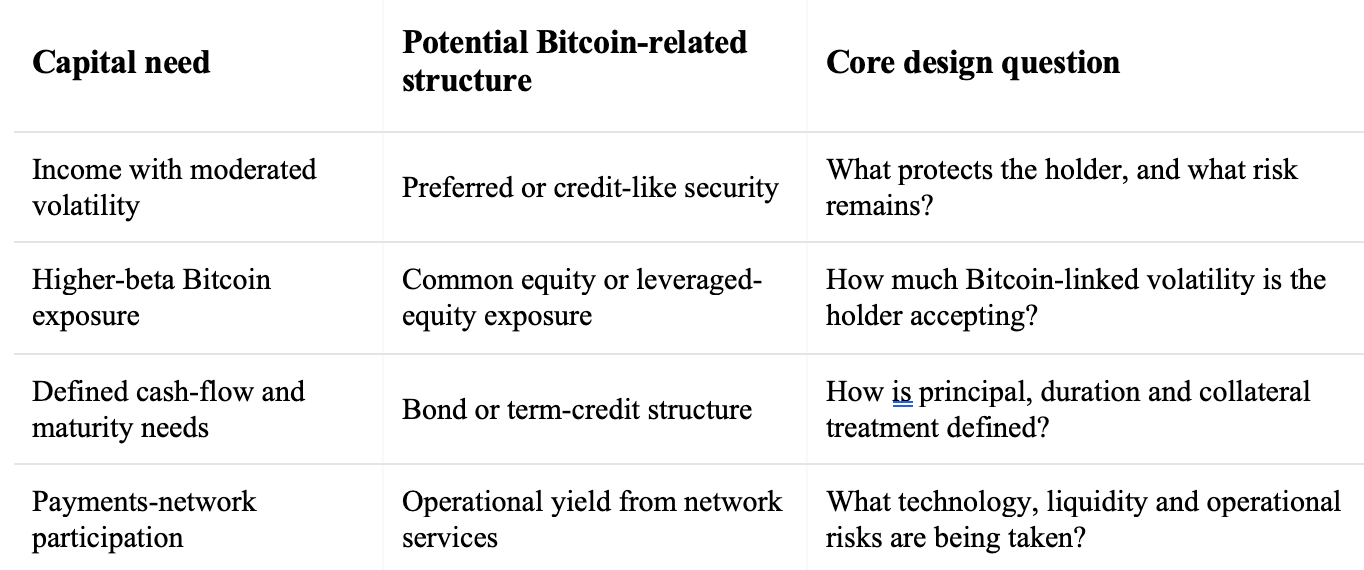
The value of this approach is not that one structure is universally superior. It is that different capital pools can choose different exposures without each having to become an expert in key management, exchange operations or direct token custody.
The Real Addressable Market May Be Fixed Income
The most provocative point in the conversation was that the largest opportunity may not sit with investors already looking for Bitcoin yield. It may sit with traditional fixed-income capital that has never been willing—or permitted—to buy Bitcoin directly.[2]
This is a subtle but important reframing.
For a crypto-native investor, the question may be: How do I earn a return on Bitcoin I already own? For a fixed-income allocator, the question is often different: Can I buy an instrument that meets my mandate, has a clear duration, fits my risk process and offers a return I can understand?
Those are not the same buyer journeys.
Many large pools of capital are defined by restrictions before they are defined by preferences. They may be unable to buy spot Bitcoin. They may be unable to hold a self-custodied asset. They may require a security that can be rated, audited, held through an approved custodian or matched to a specific liability timeline.
That is why the next stage of Bitcoin-linked credit is likely to be less about inventing a single winning product and more about building a recognisable capital stack: income instruments, higher-volatility equity, credit products and eventually a curve of instruments with defined maturities.
A perpetual preferred security may work for one investor. An insurer with future claims obligations may require a one-year, five-year or ten-year instrument with a stated maturity and principal-repayment framework. The challenge is not merely financial engineering. It is translation—bringing Bitcoin-linked economics into the investment language that existing capital already understands.[2]
Why Product Design Cannot Hide Risk
There is a temptation, especially in new asset classes, to frame structure as a shortcut to safety. The discussion pushed against that idea.
A higher yield is not a free lunch. A lower-volatility instrument does not become risk-free because it sits above common equity in a capital structure. A Bitcoin-backed credit product can still carry market risk, liquidity risk, execution risk, issuer risk, legal risk, technology risk and regulatory risk. A payments-network model may earn fees, but it also relies on software, security, liquidity management and operational resilience.[2]
The test of a credible product is therefore not whether it removes complexity. It is whether it makes complexity visible enough to be assessed.
That is a useful standard for the broader digital-assets industry. Institutions are not necessarily asking for a world without risk. They are asking for risks that can be identified, sized, approved, monitored and managed.
In that sense, the future of Bitcoin credit may be determined by a deceptively simple question: Can a professional allocator explain, in a committee room, exactly what they own and why?
Trust Moves Through Infrastructure
The phrase “Bitcoin scales at the speed of trust” captures this entire dynamic.
Trust starts with the asset. Bitcoin’s open network and verifiable ledger create a form of transparency that differs from many opaque collateral systems. But trust then has to move through every layer that sits between the asset and a large capital pool:
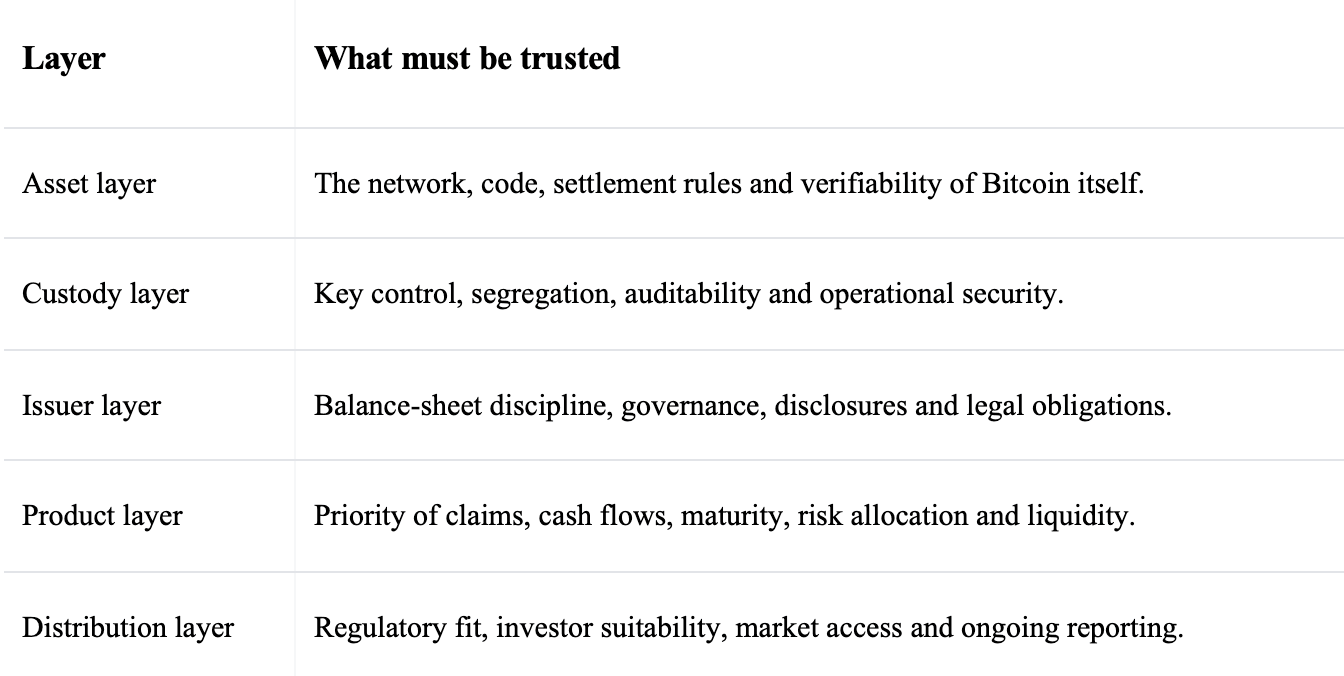
The failure of any one layer can weaken the whole proposition. That is why trust should not be treated as branding. It is an operating system.
For companies working across digital assets, capital markets and payments, this has practical consequences. Product design must begin earlier than the pitch deck. It must begin with the local regulatory environment, the investor’s actual purchase process, the credibility of the distribution channel and the operational infrastructure that supports the product after launch.
The Cross-Border Lesson: Products Do Not Travel Alone
At Candowa, we see this as a broader market-entry lesson.
Financial products rarely cross borders on product quality alone. The product may be technically sophisticated, but a new market will still ask: Who is the local counterparty? Which compliance framework applies? How will customers understand the offer? Where will support come from? How will the product be explained to partners, regulators and users who do not share the same assumptions as the home market?
The same is true for Bitcoin-linked credit. Before a capital-market instrument can succeed in a new market, it needs a system around it: trusted local relationships, compliant structures, clear communication, operational readiness and a credible path to ongoing engagement.
That is why the real opportunity is not just to build a product that tracks Bitcoin. It is to build the market infrastructure that enables the right people to use that product with confidence.
The Next Chapter Is Institutional Translation
Bitcoin’s original promise was not that every person would interact with money in exactly the same way. Its promise was that an open, verifiable, peer-to-peer monetary network could exist outside the control of a single gatekeeper.
As Bitcoin meets global capital markets, that promise is entering a more complicated phase. Direct ownership and institutional wrappers will coexist. Self-custody will remain meaningful. So will the need for products that let regulated, mandate-bound capital participate without pretending those constraints do not exist.
The winners in this next chapter may not simply be the organisations that hold the most Bitcoin. They may be the ones that can build the most credible bridges between Bitcoin’s native properties and the real-world requirements of institutional capital.
That is what it means for Bitcoin to scale at the speed of trust.
About Candowa
Candowa helps ambitious businesses build an Australia market-entry system: translating cross-border opportunity into the local relationships, market understanding and operating confidence needed to move forward. If you are building across Australia and Asia-Pacific, we would be glad to start a conversation.
Source Note and Disclosure
This article is a synthesis of presentations and panel discussions contained in a recording supplied to Candowa. It does not independently verify speakers’ numerical claims, company disclosures, product names or market estimates. The analysis focuses on the conceptual arguments presented in the recording and uses no external market-price data or performance assumptions.
[1]: QueenSt22audio transcript, approximately 03:29–21:13. Keynote discussion on Bitcoin, digital credit, transparent collateral, capital structure and institutional access.
[2]:QueenSt22 audio transcript, approximately 25:39–38:51. Panel discussion on Bitcoin yield, Lightning Network operations, fixed-income capital, product mandates and maturity structures.
This article is research and analysis only, not personalised financial advice. It is not an offer, recommendation or solicitation to buy, sell or hold any asset, security or financial product.